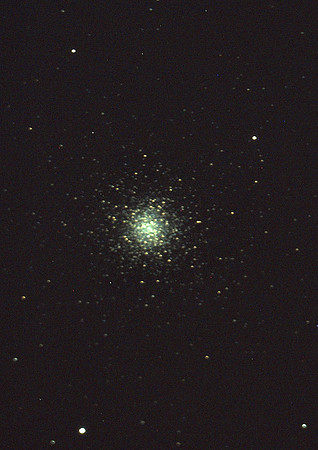
4/30/2011 10:30-12:00 midnightbr/Scope - LX50 10"br/Guide Scope - Celestron 80mm + SSAGbr/Mount - CGEMbr/Camera - Star Shoot Pro 2.0br/Exposure - 9 x 30 sec., 9 darks, 5 flats and 5 dark flats.br/Post processing - Corel Paintshop Pro.- Clarifybr/Notes - Had a hard time fine focusing the scope.br/Subject - strongMessier 3/strong (also known as emM3/em or emNGC 5272/em) is a a href="
http://en.wikipedia.org/wiki/Globular_cluster"; target="_blank"globular cluster/a in the a href="
http://en.wikipedia.org/wiki/Constellation"; target="_blank"constellation/a a href="
http://en.wikipedia.org/wiki/Canes_Venatici"; target="_blank"Canes Venatici/a. It was discovered by a href="
http://en.wikipedia.org/wiki/Charles_Messier"; target="_blank"Charles Messier/a in a href="
http://en.wikipedia.org/wiki/1764"; target="_blank"1764/a, and resolved into stars by a href="
http://en.wikipedia.org/wiki/William_Herschel"; target="_blank"William Herschel/a around 1784. This cluster is one of the largest and brightest, and is made up of around 500,000 stars. It is located at a distance of about 33,900 light-years away from a href="
http://en.wikipedia.org/wiki/Earth"; target="_blank"Earth/a. M3 has an a href="
http://en.wikipedia.org/wiki/Apparent_magnitude"; target="_blank"apparent magnitude/a of 6.2, making it a difficult a href="
http://en.wikipedia.org/wiki/Naked_eye"; target="_blank"naked eye/a target even with dark conditions. With a moderate-sized telescope, the cluster is fully defined. It is estimated to be 8 billion years old.