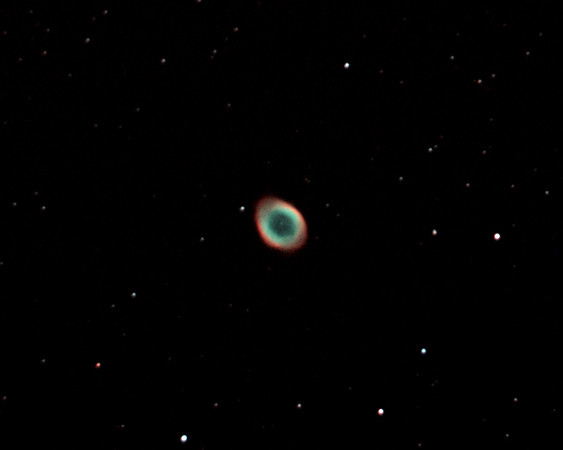
6/2/12br/Scope - LX50 10"br/Guide Scope - Orion 80mmbr/Mount - CGEMbr/Camera - Orion Starshoot 2.0br/Exposure - 2 x 100 sec.+ 8 x 70 sec.br/Processing - Levels - small adjustments. Slightly out of focus. Still having trouble getting pinpoint focus on scope. Spent most of night trying unsuccessfully to calibrate autoguider. Seemed to work with lowest exp. time on guide star.br/Subject - emM57/em or emNGC 6720/em) appears in the northern a href="
http://en.wikipedia.org/wiki/Constellation"; target="_blank"constellation/a of a href="
http://en.wikipedia.org/wiki/Lyra"; target="_blank"Lyra/a. It is a prominent example of a a href="
http://en.wikipedia.org/wiki/Planetary_nebula"; target="_blank"planetary nebula/a. This is a shell of ionized gas expelled into the surrounding a href="
http://en.wikipedia.org/wiki/Interstellar_medium"; target="_blank"interstellar medium/a by a a href="
http://en.wikipedia.org/wiki/Red_giant"; target="_blank"red giant/a star, which was passing through the last stage in its a href="
http://en.wikipedia.org/wiki/Stellar_evolution"; target="_blank"evolution/a before becoming a a href="
http://en.wikipedia.org/wiki/White_dwarf"; target="_blank"white dwarf/a. This nebula was discovered by the French astronomer a href="
http://en.wikipedia.org/wiki/Antoine_Darquier_de_Pellepoix"; target="_blank"Antoine Darquier de Pellepoix/a in January 1779, who reported that it was "em...as large as Jupiter and resembles a planet which is fading./em" Later the same month, fellow French astronomer a href="
http://en.wikipedia.org/wiki/Charles_Messier"; target="_blank"Charles Messier/a independently found the same nebula while searching for a href="
http://en.wikipedia.org/wiki/Comet"; target="_blank"comets/a. It was then entered into his catalogue as the 57th object. Apparent Mag. 8.8