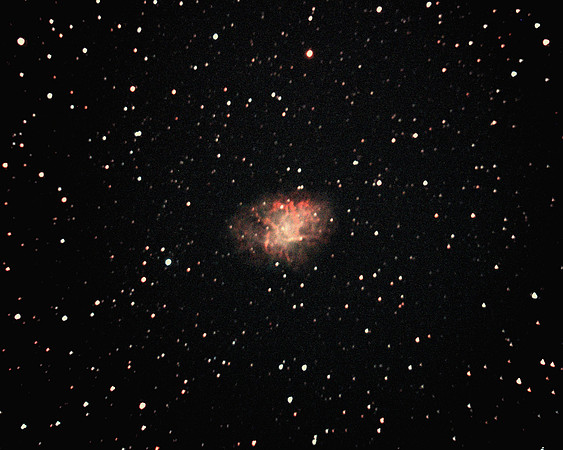
01/17/12br/The beauty of M1 was worth the wait. I'm not sure that I propery focused the scope but not bad for first attempt.br/Scope - LX50 10"br/Guide Scope - Celestron 80mm + SSAGbr/Camera - Orion Starshoot Pro 2.0 + BAADER UHC-S Filterbr/Exposure - 7 x 300 sec. + 6 Darksbr/Processing - Histogram Adjustment, Layers, RGB adj.br/Subject - The Crab Nebula, Messier 1 (M1, NGC 1952), is the most famous and conspicuous known supernova remnant, the expanding cloud of gas created in the explosion of a star as supernova which was observed in the year 1054 AD. It shines as a nebula of magnitude 8.4 near the southern "horn" of Taurus, the Bull. br/a href="
http://messier.seds.org/more/m001_sn.html"; target="_blank"The supernova/a was noted on July 4, 1054 A.D. by Chinese astronomers as a new or "guest star," and was about four times brighter than Venus, or about mag -6. According to the records, it was visible in daylight for 23 days, and 653 days to the naked eye in the night sky. It was probably also recorded by Anasazi Indian artists (in present-day Arizona and New Mexico), as findings in Navaho Canyon and White Mesa (both Arizona) as well as in the Chaco Canyon National Park (New Mexico) indicate